
By Carrie Sanders
For the past several years, I’ve had a front‑row seat to a growing paradox in church redevelopment. Across the country, churches, synagogues, and other faith institutions are sitting on irreplaceable land, deep community trust, and a clear sense of mission, yet they remain locked out of capital, often stalled in predevelopment, and overwhelmed by a system not designed for them. At the same time, communities face historic shortages of affordable housing, childcare, senior housing, and neighborhood‑serving space.
The question is not whether faith‑owned real estate will change. It is not even whether it will be developed. The real question is who will shape that transition, and to what end.
The 2025 Fieldworks Initial Research Report from RootedGood made something unmistakably clear: this is not a lack‑of‑vision problem. It’s a systems problem. Again and again, the same barriers surface: opaque capital stacks, inconsistent underwriting standards, fragmented intermediaries, and no shared definition of what “investment‑ready” actually means.
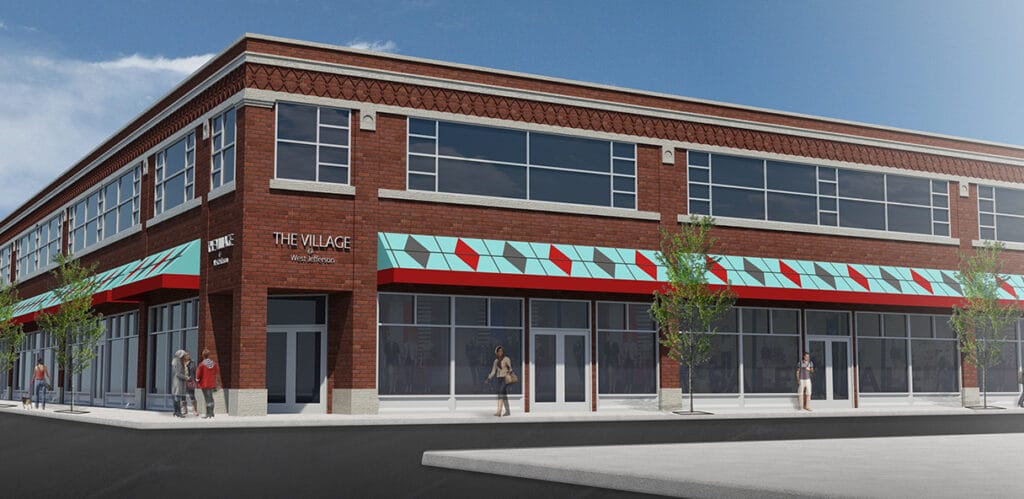
The United Church of Christ Church Building & Loan Fund (CBLF) partnered with St. Peter’s UCC in Louisville, KY to create the $7.9 million MOLO Village CDC project. The 30,000-sq-ft development, known as “The Village @ West Jefferson” and featured in an award-winning documentary, transformed a church parking lot into a community hub with a restaurant, cafe, and services.
McCormack Baron Salazar. (n.d.). MOLO Village CDC building [Photograph]. https://www.mccormackbaron.com/community-profiles/molo-village-cdc*
If faith-owned land is going to play a meaningful role in housing, childcare, community facilities, and neighborhood resilience, from my perspective, the most urgent gap is translation. Churches speak theology, mission, and calling. Capital speaks risk, return, and structure. Too often, developers and intermediaries are left to piece together something that satisfies neither side. The result is stalled projects, burned relationships, and communities that continue to wait.
What we know is deals move when someone is willing to quarterback the entire pathway: vision to feasibility, feasibility to financing, financing to execution. That means standardized predevelopment pathways, templated deal structures, clear readiness criteria, and intermediaries who understand both congregational decision‑making and complex capital stacks.
The Village at West Jefferson in Louisville is a compelling example of what becomes possible when church-owned land is paired with the right development structure and partners.
On a strategic vacant lot owned by St. Peter’s United Church of Christ, an underutilized site was transformed into a two-story, 33,000+ square foot community hub serving the Russell neighborhood. Today, the building houses a mix of mission-aligned tenants including MOLO Village Community Development Corporation, the Louisville Independent Business Alliance, Norton Healthcare, Park Community Credit Union, the Ohio Valley Educational Cooperative, and the Louisville Metro Housing Authority, alongside food service and community-serving uses.
But the real story here is not the building. It is the alignment behind it.
This project came together because the core ingredients were present and working in sync. Church Building & Loan Fund provided mission-aligned capital and a deep understanding of faith-based real estate. McCormack Baron Salazar brought experienced, disciplined development execution. A coordinated team of consultants helped structure the deal, navigate complexity, and keep momentum. And critically, the church itself had both the vision and the willingness to engage in a structured, and at times demanding, development process.
Too often, church-owned redevelopment efforts stall because one or more of these elements is missing. There may be vision without execution, land without a capital strategy, or partners without alignment. Here, those pieces came together. The church held onto its mission. The developer brought a proven model. The capital stack was intentional. And the advisory team helped translate between them.
Projects like this do not come together through vision alone, and they are rarely the result of any one organization’s effort. They require a set of aligned partners, each taking responsibility for a different piece of the work and a different layer of risk. The church brings the land and a clear sense of mission. The developer brings discipline, structure, and the ability to execute. Capital enters when there is clarity around both. And the advisory team plays a critical role in translating between these perspectives, holding the process together from early concept through closing.
If we are serious about unlocking the scale of faith-owned land in this country, we have to be equally serious about the limitations of the current system. Churches are not positioned to carry predevelopment risk on their own, nor should they be expected to. Developers cannot absorb that risk indefinitely without distorting their own models. And capital, particularly institutional capital, will continue to sit on the sidelines unless these projects can be understood, underwritten, and replicated with confidence.
That is not simply a project-level challenge. It is a capital market challenge.
At Hope Community Capital, we see our role as helping to reshape that landscape by building the connective tissue between vision and capital. That means more than assembling one-off deals. It means developing clearer pathways from early-stage concept to financeable project, creating consistency in how these opportunities are structured, and helping capital providers engage with faith-owned real estate through a more disciplined and transparent lens.
This work is inherently collaborative, and it depends on strong developers, mission-aligned lenders, and churches that are willing to steward their assets with intention. At the same time, it requires leadership to establish patterns that can be repeated, standards that can be trusted, and a framework that reduces uncertainty across the system.
Without that kind of structure, most faith-owned sites will remain exactly where they are today: valuable, well-located, and largely untapped. With it, they begin to function differently, not as isolated projects, but as part of a broader, investable landscape.
The opportunity, then, is not only to complete individual developments, but to change the way capital flows into this space altogether. If we are willing to do that work, one project at a time but with a clear eye toward system-level change, faith-owned land has the potential to become one of the most important and overlooked platforms for community development in the country.