
By Sierra Johnson
Spring is the season of renewal; a time when communities shake off the weight of a hard winter and begin investing again in growth, connection, and possibility. In many places across the United States, that metaphor feels particularly resonant. Communities are navigating compounding challenges: climate‑related disasters, public health gaps, economic stress, and aging infrastructure. The question is no longer whether disruption will occur, but whether communities are prepared to handle it and emerge on the other side.
Across the country, a new model of community infrastructure is taking root that reframes resilience not as a reaction, but as a daily practice. Community resilience hubs are showing what it means to blend essential services, trusted spaces, and resilient infrastructure into places that support people year‑round and during crises alike.
Beyond Bouncing Back: What Are Resilience Hubs?
Resilience hubs are community‑serving facilities embedded within neighborhoods, expanding their role during emergencies. As defined by the Urban Sustainability Directors Network (USDN), these hubs are typically, and intentionally, built on existing, trusted institutions, like community centers, schools, health clinics, libraries, cultural spaces, or faith‑based facilities, designed first as daily-use neighborhood anchors that also strengthen equity, climate adaptation, and social cohesion. These trusted places are enhanced to offer wraparound services and to pivot during emergencies, serving as staging points for response.
What distinguishes resilience hubs from traditional emergency shelters is their dual‑use nature. FEMA promotes a “whole community” approach, underscoring that community assets, existing facilities, and social networks are essential for preparedness and response. Resilience hubs are public-serving spaces that provide shelter and essential services during extreme weather, natural hazards, or other events that cause or contribute to an emergency or disaster, such as dangerous wildfire woodsmoke. These community-level resilience hubs can also serve as community-convening spaces that provide educational activities and related emergency and disaster preparedness resources to community residents year-round.
This everyday-plus-emergency model is highly effective. Research and practice show that facilities designed solely for disaster response are often underutilized and poorly connected to residents. Resilience hubs invert that logic: they are most effective precisely because they are already integrated into daily community life.
The Rocky Mountain Institute (RMI) further highlights the benefits of providing reliable power, communication coordination, facility access, and programming, particularly in vulnerable neighborhoods often hit hardest by climate disasters. Many disadvantaged communities lack the resources to evacuate in a safe and timely manner when disaster strikes or is imminent. When these hubs are strategically located, enabling walkable access for those less likely to drive, and in areas more susceptible to grid failures, extreme temperatures, and disruptions, it strengthens both use and effectiveness during crises.
Anchor Facilities: The Heart of a Multi‑Use Hub
At the core of many successful resilience hubs is an anchor facility: a stable, long‑term institution with deep community roots supporting everyday community renewal. Anchor institutions provide continuity, governance, and trust, allowing multiple services and partners to co‑locate in one place.
The anchor‑facility model amplifies resilience in several ways:
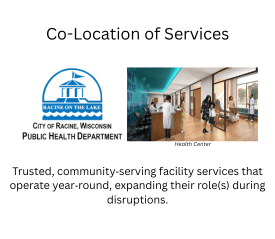
- Co‑location of services reduces barriers to access and strengthens collaboration among providers.
- Shared infrastructure, such as solar plus storage, communications systems, and flexible community space, supports both daily operations and emergency functions.
- Diverse uses improve financial sustainability, ensuring facilities remain viable beyond grant cycles or crisis moments.
Importantly, resilience hubs are not intended to replace public emergency systems. Federal agencies, including the Department of Homeland Security (DHS), increasingly recognize hubs as complementary, community‑based infrastructure that enhances preparedness while reducing strain on first responders during disasters.
Resilience Requires Capital
While the physical design of resilience hubs often receives attention, financing of these hubs is also critical. Community resilience depends on financial stability.
Patient, mission‑aligned capital enables communities to:
- Acquire or redevelop anchor facilities.
- Invest in energy efficiency, solar, and battery storage to maintain operations during grid outages.
- Build flexible, multi‑tenant spaces that serve diverse needs.
- Plan for long‑term operations rather than short‑term program survival.
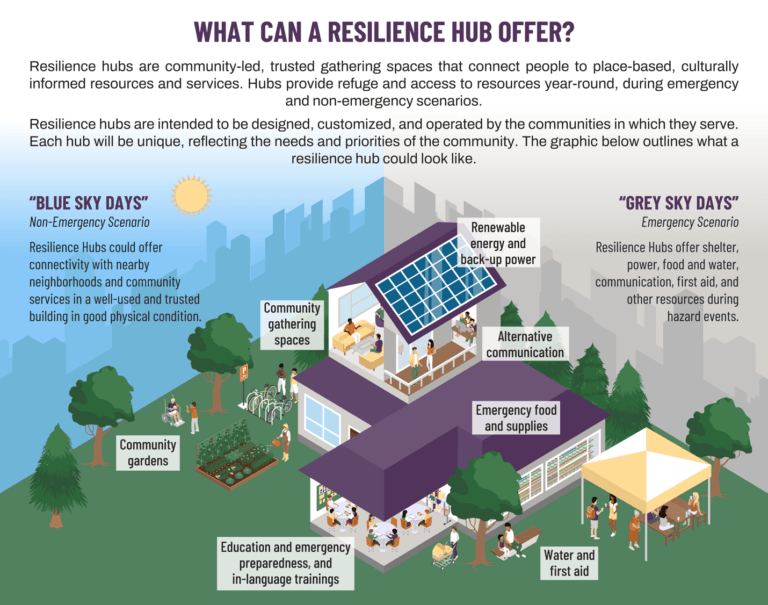
Diagram of a house with solar panels (Center for Climate and Energy Solutions, 2025).
Without the right capital, even the most thoughtfully designed hub can struggle to sustain its impact. Increasingly, practitioners are aligning community development finance, clean‑energy investment, and public funding to support hubs that deliver both “blue sky” benefits in normal times and “grey sky” resilience during crises.
Lincoln‑King: A Real‑World Example of Everyday Resilience
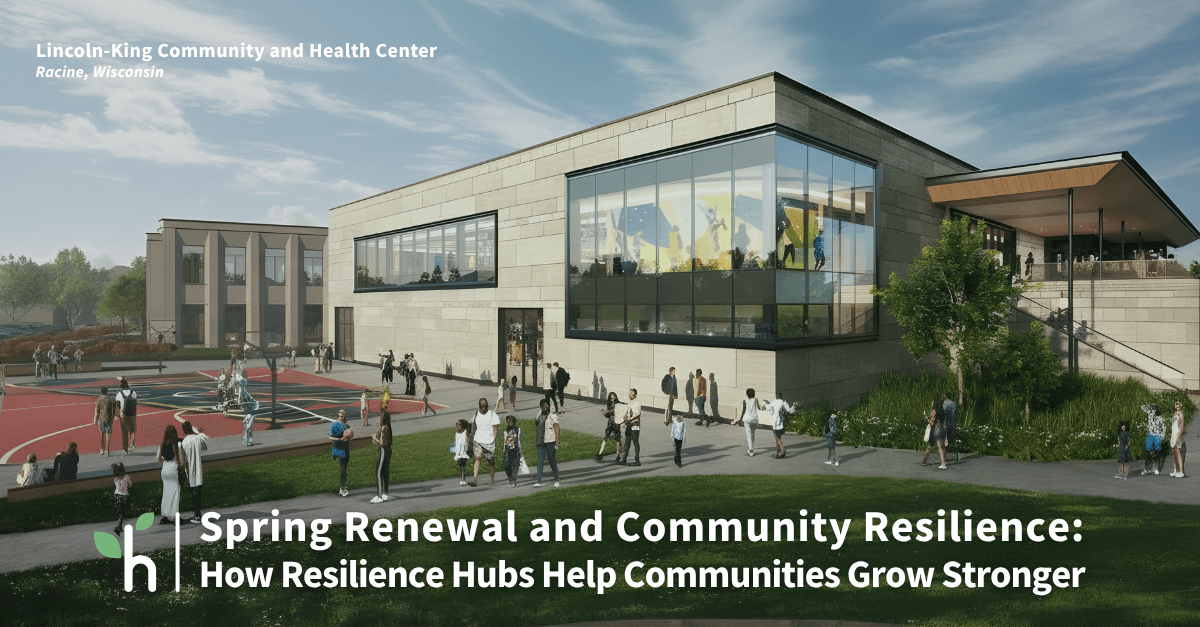
The Lincoln‑King Community & Health Center in Racine, Wisconsin offers a tangible example of how resilience hubs take shape when capital, community vision, and anchor institutions align, an approach Hope Community Capital supported through its work on this project.
The $68 million Lincoln‑King project brings together a community center, a Federally Qualified Health Center, and the City of Racine Public Health Department into a single, multi‑use campus serving one of the city’s most historically disinvested neighborhoods.
Spanning nearly 78,000 square feet, the facility is designed to deliver holistic, everyday services from preventive healthcare and behavioral health to youth programming, senior activities, workforce development, and wellness offerings. At the same time, it incorporates resilient, future‑focused infrastructure, including geothermal heating and on‑site solar generation, positioning it as Racine’s first net‑zero building.
In practice, Lincoln‑King functions as more than a building. It is a trusted neighborhood anchor, shaped by community input, positioned next to a public elementary school, and designed to meet both immediate needs and long‑term aspirations. In moments of disruption, whether a heat wave, public health emergency, or power outage, it can serve as a stable, equipped place for connection, care, and coordination. In ordinary seasons, it is a place of renewal.
Lessons from the Field: What Makes Hubs Work
Insights from national resilience‑hub networks highlight several consistent lessons, that HCC embeds in our work daily:
- Design for everyday use first. Hubs that are busy, valued spaces on “blue sky” days are far more effective during emergencies.
- Integrate clean energy and defensible retrofits. Solar plus storage, efficient envelopes, and telecommunication systems allow hubs to operate during outages while reducing long‑term operational costs and emissions.
- Prioritize equity and trust. Successful hubs are community‑led or community‑managed, with local organizations integrated into community-wide emergency plans.
- Plan for operations, not just construction. Governance, staffing, and sustainable financing are as important as bricks and mortar.
Federal recognition is catching up to this practice‑based knowledge. DHS and FEMA increasingly emphasize local preparedness, community infrastructure, and data‑driven resilience planning, acknowledging that strong neighborhoods are foundational to national resilience.
Renewal, Built Over Time
Resilience is often framed as a response to crisis. But resilience hubs remind us that it is, at its core, about continuity, care, and connection. These are places where communities don’t just survive disruptions; they prepare, adapt, and grow stronger together.
As spring returns each year, it offers a useful reminder: renewal doesn’t happen all at once. It is the result of seeds planted early, tended patiently, and nurtured by the right conditions.
By investing now in anchor institutions, resilient infrastructure, and mission‑aligned capital, we can build places that sustain communities through every season, whatever the forecast may bring.
FEMA Program
FEMA has published the Fiscal Years 2024/2025 funding opportunity for the Building Resilient Infrastructure and Communities program. The application period opened on March 25, 2026, and will run for 120 days. The deadline to submit applications is July 23, 2026. Eligible applicants and sub-applicants must apply through FEMA Grants Outcomes (FEMA GO). The full notice of funding opportunity is published on Grants.gov.